Travel to Utrecht & GHG emissions
Please keep checking for updated train schedules at https://9292.nl/en/.
Travel to Utrecht by public transport
Utrecht has an efficient, well-connected public transport system that makes it easy for visitors to travel within the city and throughout the Netherlands. The network consists of trains, trams, and buses, supported by a unified national ticketing system. For detailed information and prices see https://dutchreview.com/traveling/public-transport-in-the-netherlands/.
Train
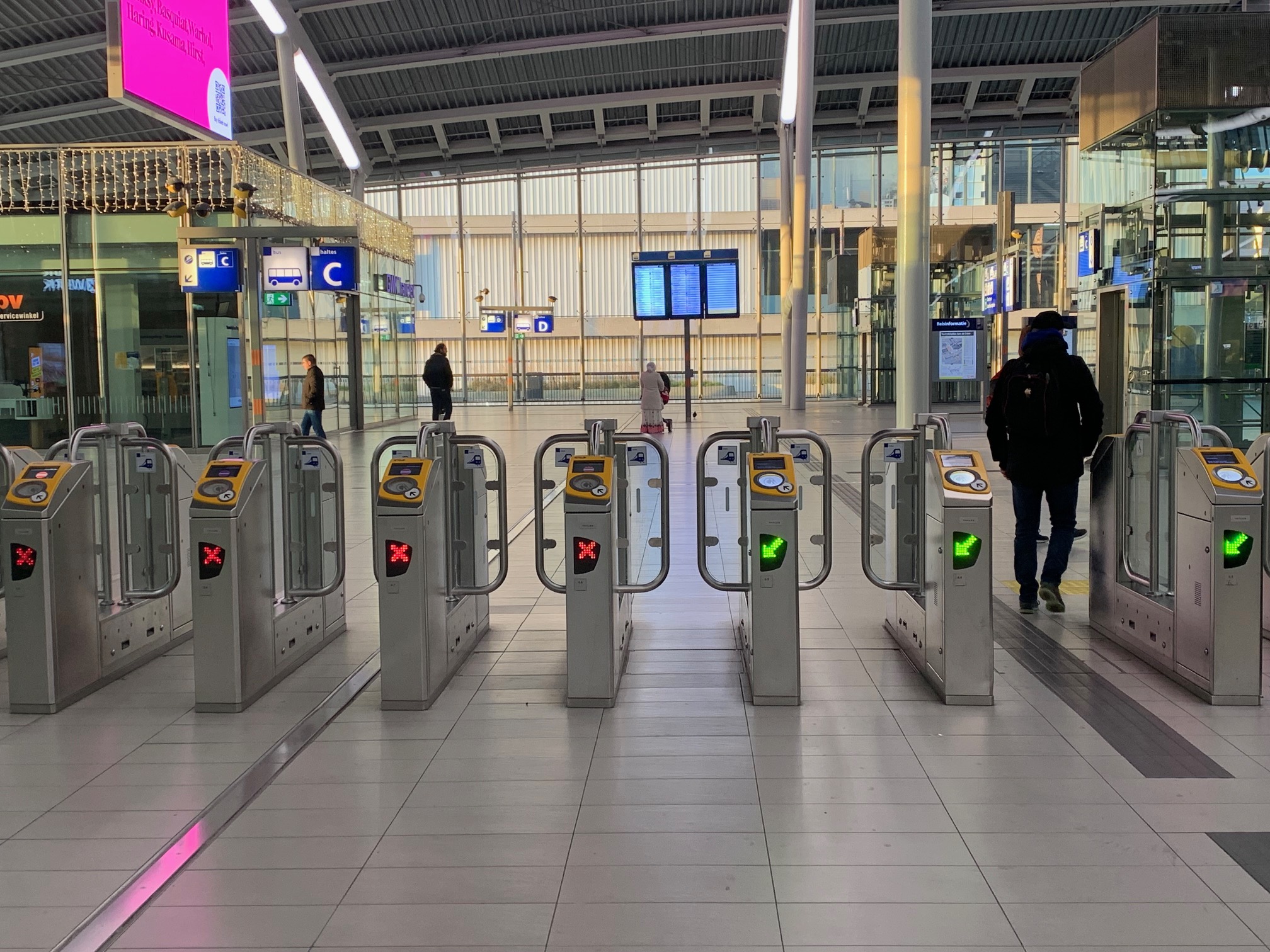
Arriving by the train in the Netherlands: Be aware that at most stations you will have to pass barriers to get onto the platform or out of the station. For an international ticket the QR code on your phone or the printed copy should work to let you pass.
The Utrecht Central Railway Station is the Dutch main railway hub. Utrecht is connected to Schiphol Airport/Amsterdam, to Berlin/Hannover/Osnabruck, to Munich/Frankfurt a.M, and to Barcelona/Paris/London-Brussels/Rotterdam. Railway is also a convenient means of transport within The Netherlands, given that distances within the country are mainly short and most lines operate a 15-min schedule. Frequent intercity trains connect Utrecht with Amsterdam (Schiphol airport, ca 30 minutes), Rotterdam, The Hague, and other major cities. Local "sprinter" trains serve nearby towns such as Houten, and Amersfoort. Trains operate early in the morning until around midnight.
To help your research on the best option for your journey from across Europe by train, find links that provide some information on options for travelling throughout Europe by train.
- A wealth of information and links on how to get to Utrecht by train: The man in seat 61 – highly recommended source.
Example: European departures to Amsterdam - Information on trains across Europe, rail passes, and booking system.
- Trains within The Netherlands: e-tickets can be purchased online; for travel planning, tickets & prices, and services check out: www.ns.nl.
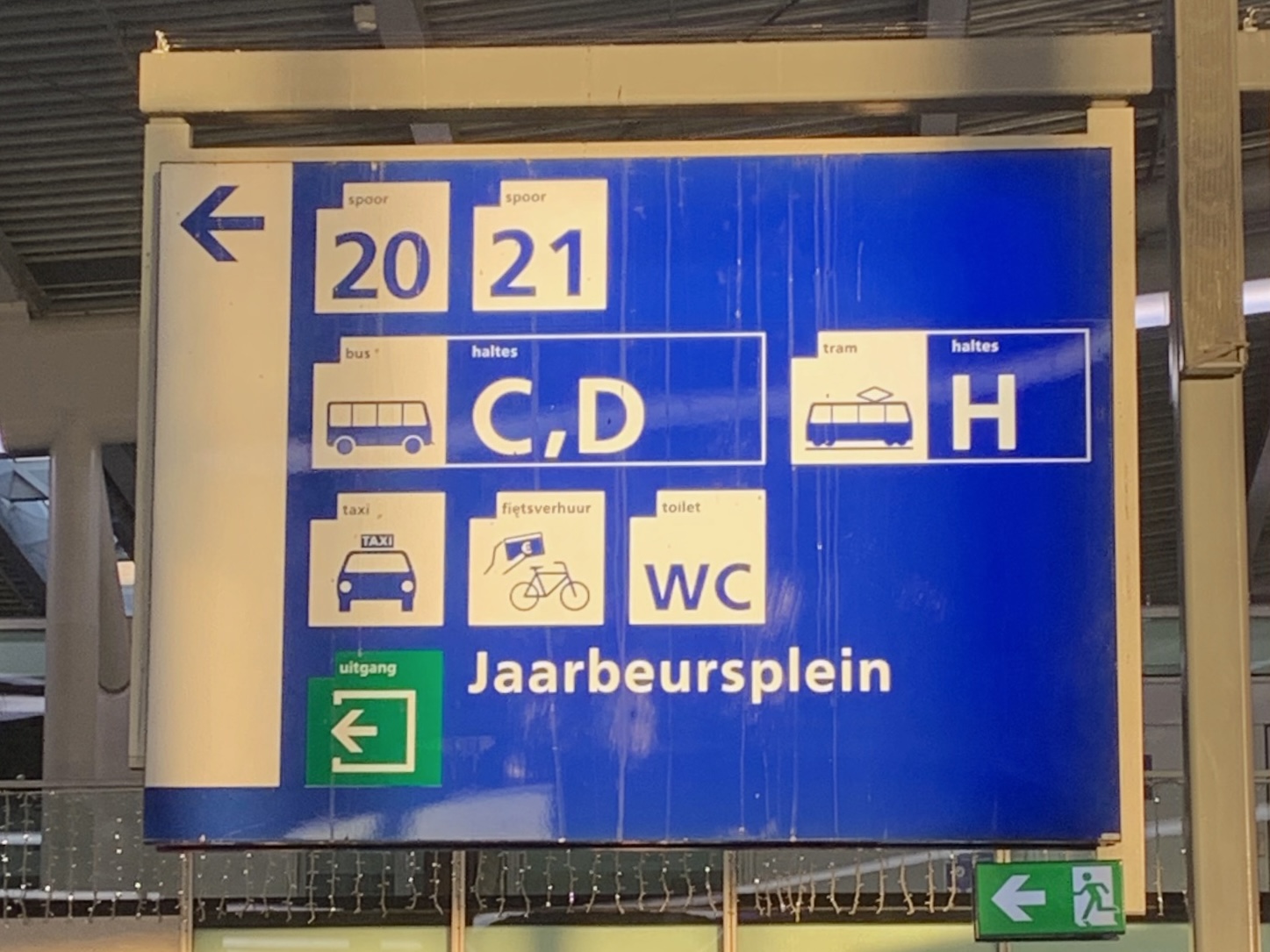
The Jaarbeurs conference centre is a 5-minute walk (approx. 500m) from the main train station away. Follow the signs for “Jaarbeursplein” from Utrecht Central Station.
Bus
An extensive bus network covers the entire city and surrounding region. Buses connect residential areas, business districts, and conference locations. Most lines run every 10–15 minutes during the day. Go to http://www/9292.nl/en/ for detailed information about travelling by public transport. International bus lines to Utrecht are operated by Flixbus and Busbud.
Travel to Utrecht by plane
Utrecht is connected with Amsterdam Schipol airport via a direct train that takes 30 min., and connected to Rotterdam/The Hague Airport via bus and train (1 hour).
Emissions offset
- Typical values for emission equivalents produced by air travel are between 250g/km for short domestic flights, and 150g/km for long-haul flights. A return flight for example from Amsterdam to Ljubljana thus results in roughly 195kg CO2 emissions (2,152 km; economy class, scheduled flight; 432 kg CO2 with climate impact of contrails, ozone formation, etc. included): https://www.atmosfair.de/en/reduce/fix/
- Taking a long-distance train will reduce emissions by 99%: 2kg CO2: 2kg CO2 for 2476km (return) https://ecotree.green/en/calculate-train-co2
- Detailed calculations for your trip can be investigated for example at:
https://ecotree.green/en/calculate-train-co2
https://ourworldindata.org/grapher/carbon-footprint-travel-mode or
https://www.icao.int/environmental-protection/CarbonOffset/Pages/default.aspx
https://www.atmosfair.de/en/reduce/fix/
EMS travel rules updated
In the context of developing the Net Zero pledge the EMS has also updated its travel reimbursement rules. For recent years, most people on EMS mission have chosen train rides over air travel, but EMS has now inscribed this in its rules. Main points are:
- Travel shall normally be by the most economical route and means of transport and aiming at minimal GHG emissions. In principle, for a total travel time less than 24 hours, train travel should be chosen, or other means that have a low GHG emission-effect like by bike. Exceptionally, account may be taken of the time saved by using a somewhat less economical route or means of transport.
- It is mandatory to collect GHG emission statements. These statements complete the reimbursement claim and are needed to support the calculation of EMS’s CO2 footprint. If no certificate is available (e.g. no information coming with the ticket/receipt), a best-guess should be given (based on the distance travelled and means of transport).
We invite delegates to follow this example.
Supporters & sponsors